Sign up for weekly new releases, exclusive access to live debates, and Open to Debate’s educational newsletters.
In a world being reshaped by vital questions about Al, sustainability, and an uncertain global economy, now is the time for decisive action.
As a Knowledge Partner with the Future Investment Initiative (FII) Institute, this episode will showcase the power of debate and its positive impact on humanity.
With the debut of a new, engaging format, featuring three fast-paced rounds, six debaters take on questions of Money, Truth, and Power in a debate titled “Clash of the Titans.” The debate examines three provocative questions with three sets of influential debaters: whether the future of currency is fiat or crypto, whether Al will change the nature of truth, and whether it’s time to give even more power to tech companies.
You will also hear an excerpt of our “UNRESOLVED: What’s Europe’s Economic Outlook?” in which you will hear three influential titans of industry debate whether investors should make a bet on Europe. In a full-standing debate on the popular topic of Al, you’ll hear a spirited discussion about whether Al art can generate the emotional impact of traditional art and whether Western influence will dominate its evolution.
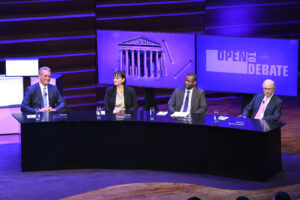
These debates took place at the King Abdulaziz International Conference Center in Riyadh, Saudi Arabia during FII8. Full versions of these debates can be found on Open to Debate and FII Institute’s YouTube channels.
Clash of Titans: Debates on Three Grand Challenges Facing Humanity
Unresolved: What Is Europe’s Economic Outlook?
Unresolved: Will AI-Generated Entertainment Replace Human Creativity?
John Donvan
I am John Donvan, your moderator-in-chief. Hi everybody.
This week we go on the road. We’re out in the field. Actually, we went to Riyadh, Saudi Arabia. Took our whole team along to partner with the Future Investment Initiative Institute, which is a global nonprofit that centers its mission on innovation’s positive impact on humanity. And it does that by gathering together thinkers and innovators from around the world, getting them together to try to turn ideas into real world solutions.
We see this as part of Open to Debate’s own global expansion, and our mission to open minds about challenges and grand challenges on an international stage. Given our mission to elevate public discourse and collective cooperation for the good of all.
We were pretty pleased to present debates on some vital topics to a very broad international community in Riyadh, thus advancing the goal of creating civil dialogue to figure out the best ways to have the best impact on our shared future. So with that knowledge on your part, here’s a look at what we did at FII. We sat down with the CEO of the Future Investment Initiative, Richard Attias, to ask him about why we, Open to Debate, were invited to participate as a knowledge partner, and what he hoped we would bring to the annual gathering.
Richard Attias
Debate is extremely important because this is always from provocative conversation, from creating opposition between ideas that you help people to make their own opinion. And at the end of the day, what is important is to have multiple opinions, because I would say that on many topics like the future of Europe or like the future of renewable energy or like, uh, is AI killing jobs or creating jobs, you need to hear different opinions to make your own opinions. So you cannot be a curator of debates and ideas unless you bring different opinions around the same table. And this is what I think is refreshing. This is what is instructive, and this is what is helping everyone to progress and to acquire his or her own opinion.
John Donvan
And that debate energy is what we brought to the main stage of the FII Conference with the program that we called Clash of the Titans. And in that we brought together six intellectual and corporate titans to take part in a series of three debates.
Now, typically, our debates take on one topic, but this is different. We’re gonna do three debates, do them quickly, three in a row, and they’re gonna be around three themes. Those themes are money, truth, and power. We do have ground rules. The debaters are strictly timed. Two minute openings and one minute rebuttals. And then we move on to the next topic. So let’s get started with our first topic, and that one is money.
And I would like to welcome our first two debaters to the stage. First, please welcome Dr. Saifedean Ammous. Dr. Ammous is an economist and bestselling author. His most recent publication is Principles of Economics. And Mr. Robert Rosenkranz. Robert Rosenkranz is chairman of Delphi Capital Management, as well as founder and chairman of Open to Debate.
Once again, the topic is money. And here is the specific question we are gonna ask you to take on. Is the future of currency crypto or fiat?
Saifedean Ammous, you go first. You have two minutes to answer the question, which once again, is it fiat or is it crypto?
Dr. Saifedean Ammous
First of all, thank you so much John, and thank you everybody for inviting me to FII. It’s an honor and a pleasure to be here. I’m gonna make my comments as quick as I can. So Bitcoin’s rise in the last 15 years for me has exploded two of the most important myths surrounding money. They’re self-serving myths promoted by governments over the last century, which I don’t think hold up.
The first myth is that money supply needs to expand to accommodate growing economic activity. But we look at Bitcoin. In the past 10 years, Bitcoin’s supply has only expanded by about 50%, whereas the size of the Bitcoin economy has gone up by about 10,000%. So the money supply does not need to grow to keep up with the size of the economy. And I think this is an enormously important point. And the entire idea of having a monetary policy is built on this.
And Bitcoin shows us that that’s not necessary. The market is capable of choosing the money on its own, and it ma- the market chooses the asset that is the hardest. And that is the second myth surrounding money, which is that money is the choice of government. But history shows with gold, gold predates all of the world’s governments as money. Governments did not legislate gold into becoming money. Governments have to make their own money out of gold in order for the market to accept it as money. They have to accept the market’s choice for money.
And this is what we’re seeing now with Bitcoin, where Bitcoin is one of the la- 10 largest currencies in the world, and it has no state sanction behind it. It’s not the state anywhere that has made Bitcoin money. So what ends up happening on a free market is that the market chooses the hardest asset to produce as money because it’s hold on, it holds onto its value.
This happens in two ways. Either people recognize this and choose the hardest money, in which case they benefit at the expense of the people who use the easier money, or people don’t recognize it and just find that their wealth disappears and all the wealth ends up in the hands of the people who have the hardest money. This is exactly what’s going on with Bitcoin right now. Bitcoin continues to rise because it is hard, whereas government monies are easy to produce, and so they continue to lose value.
So people today need to accept this and understand it, and I think Bitcoin is the most advanced form of money because of this, and it will continue to rise and it will replace government money.
John Donvan
Thank you. You have hit time. Robert Rosenkranz, we know where you stand with the way that this is set up, but I wanna launch you by asking the question, is currencies future fiat or crypto?
Robert Rosenkranz
Well, as a, uh, titan of finance, I think that money has to meet three criteria. It’s gotta be a store of value, it’s gotta be transacted by trustworthy intermediaries, and it has to be ease of transaction. And I’d say that Bitcoin fails miserably on all three counts.
As a store of value, there’s no underlying asset whatsoever. Its value relies on popular delusions and the madness of crowds. In the la- since 2011, there have been four occasions when Bitcoin has lost more than 80% of its value. And yes, fiat currencies erode in value over time, but that, that is usually offset by their interest income.
Then the question of trust of the intermediaries. The largest Bitcoin exchange in 2014 was Mt. Gox, the largest in 2022 was FTX. They both had spectacular bankruptcies. The largest now is Binance. It was just fined $4 billion for, for its misfeasances.
And then on ease of transaction. So Mastercard in two minutes processes 300,000 transactions. The BT ledger takes a full day to, uh, to process 300,000 transactions. And to do it, it uses the entire power supply of the nation of Poland. This is insanely inefficient and wasteful. So on, on those grounds, I would say that, uh, Bitcoin has major, major failures as money.
John Donvan
Thank you very much. Time for rebuttal. Dr. Ammous, you have one minute.
Dr. Saifedean Ammous
On the issue of store of value, even with all of these 80% drawdowns, Bitcoin has outperformed every financial asset over the last 10, 15 years. In fact, there … I don’t think there’s any money manager who’s outperformed Bitcoin over the last five, 10 years. All those people charging fees to manage money cannot match just simply buying and holding Bitcoin because they’re playing a game in a rigged currency where the currency is constantly valued. So you need to run extra fast just to stay where you are because the currency is designed to lose value. Whereas with Bitcoin, because the currency is fixed in supply, simply the increased demand and as people recognize and understand that this is a fixed supply currency that nobody can inflate, that on its own is causing its value to appreciate more than pretty much any investment in the fiat world.
On the issue of exchanges, Bitcoin does not require exchanges to operate. In fact, that’s the whole point. The whole point is that you are the one who’s in charge of a currency. You can decide what you do with it, and nobody can take it away from you because it’s cryptography, it’s math. It’s not, um, money.
And on the issue of energy, I think this is a failed comparison, which I discuss in my book. Bitcoin is not a pay- consumer payment system. You can’t compare [inaudible
:37] transactions. It’s this final settlement platform.
John Donvan
Thank you very much. Mr. Rosenkranz, you have the last word. One minute rebuttal.
Robert Rosenkranz
Well, my opponent has made a lot of the fact that the supply of Bitcoin is limited. Well, so are the s- is the supply of Picasso’s, and that does not make Picasso money. And he’s also talked about the fact that government doesn’t have its hands on Bitcoin, but that’s because the a- anonymity of Bitcoin enables a lot of nefarious activity from, uh, ransomware payments to drug dealers, to financing terror networks. Government establishes the value of money by making it legal currency, by making it the means of which you can pay debts, pay your taxes, et cetera, et cetera and it has every reason to ban or heavily regulate, uh, Bitcoin. So in my view, Bitcoin ain’t money, and in my view, it never will be.
John Donvan
That is a wrap on this round. Thank you very much, gentlemen.
Now we move on to our second debate. The theme in this one is truth, and I’d like, uh, to welcome to the stage again with a round of applause, uh, first, uh, Sir Martin Sorrell, who is founder and executive chairman of the S4 Capital Group. Sir Mou- Martin, welcome. This side, sorry.
And Xenia Wickett. W- uh, Ms. Wickett is the founder of Wickett Advisory and is an executive coach, an international advisor. Ms. Wickett, thank you. Welcome to the stage.
I said the theme of this, uh, issue is, this round is truth and the degree to which truth may be disrupted by technology or is it being enhanced? And the advent of artificial intelligence has certainly raised this topic to new levels of relevance.
So here is the question, and you’ll go first, Sir Martin. Will AI change the nature of truth? You have two minutes to respond.
Sir Martin Sorrell
Thanks, John. Good morning everybody.
So three, three very simple points. Firstly, AI, AGI depends on data. Garbage in, garbage out. So the, the data that is supplied to AI models is absolutely critical and control of that data or influence on that data will be essential.
That data is going to be increasingly supplied by very large companies. Companies that effectively are countries. If you equate market capitalization with GDP, a $3 trillion company would be the size of a France or a Germany, almost a Germany, an Italy, uh, Spain or indeed a UK. Uh, and those c- those companies will have enormous responsibilities in terms of the way they, they collate the data, ingest the data, use the data. So critically important is how those companies are regulated.
And the third point is there has to be self-regulation. Governments don’t have the capacity or the resources or the capabilities that these large companies have. The regulatory agencies cannot move as fast and as quickly as those companies are moving or will move in the future, particularly given the needs, the capital needs of those companies around energy and compute power. So self-regulation, working together to work on the truth and what the truth is, is critically important. So self-regulation in partnership with government is the way forward in the absence of Armageddon, in terms of regulation, an AT&T, uh, or the type breakup of the, of the scale that we’ve seen, for example, in the oil industry historically.
John Donvan
This is Open to Debate. We will beginning to our second debate, Will AI Change the Nature of Truth, in just a moment.
Hi everybody, I’m John Donvan, and we are back with the second round of our Clash of the Titans debate. Will AI change the nature of truth? Our debater, Xenia Wickett, begins with her opening statement.
Xenia Wickett
Thank you. Thank you. Truth is an unchanging objective constant. AI can’t alter it. The ally is one World War II. Two plus two equals four. AI might distort, might manipulate perceptions, but the facts remain the same. AI doesn’t change the nature of truth. AI might generate deep fakes, false information, but it cannot change the underlying reality. The moon landing happened in 1969, no matter how it might be portrayed. Perceptions, shift truths do not. AI only affects how we access the truth, not its essence.
Technology does change access, but it does not change truth. Across history, the printing press, internet, social media have changed how we access truth, but the truth nevertheless, remains constant. Whether we learn through books or we learn through AI, Britain has a parliament. Technology does not redefine the facts. Truth has three fundamental characteristics. First of all, it is objective. It is fact-based. Secondly, it reflects reality. It corresponds to what actually is. And thirdly, it is independent of how it is discovered. The method of finding truth, whether through AI or otherwise, doesn’t affect the truth itself.
AI might sp- change perceptions or create alternative narratives, but truth’s essence remains unchanged. AI is a facilitator, but it is not an arbiter. It helps us access and filter data, but it does not generate the truth. It is a tool, not a creator of truth. It may help per identify truths, but that is where it ends.
John Donvan
Thank you very much. Uh, Sir Martin, your one-minute rebuttal.
Sir Martin Sorrell
Well, tru- truth is subjective. I mean, news- newspaper barons have always influenced truth. We’ve seen where owners of media seek to influence opinion in one way or another by endorsing or not endorsing candidates. You mentioned the moon landing. Some people believe that that moon landing never took place. That it was some cinematic or movie produced, uh, reel that people were, were seeing. Where so the, the truth that you refer to can be influenced. And unfortunately, in the context of AI and AGI, there will be bad actors and we will have to control those bad a- actors or stop them from influencing some people in, in unsatisfactory ways.
In the current conflicts that we see taking place, sadly, in Eastern Europe and indeed in the Middle East, truth is influenced in the, the new media, the social media that we see-
John Donvan
I’m sorry-
Sir Martin Sorrell
… in many, many ways-
John Donvan
At time.
Sir Martin Sorrell
… and AGI certainly do that too.
John Donvan
And Xenia Wickett, your rebuttal, please?
Xenia Wickett
Thank you. So Martin, I’m so pleased you brought that up. Thank you. Because what you are talking about is perception, and there’s no question at all. I a 100% agree with you. AI alters perception. It doesn’t alter reality. It doesn’t alter the truth. AI can manipulate how we perceive what we perceive. It can manipulate how information is delivered, but the underlying truth remains the same.
So yes, you are a 100%. We live in a world that is hugely complex. We live in a world where people are bringing out new facts, we live in … or new perceptions. We live in a world that many describe as a post-truth world. But that is about information overload. That is about manipulation.
John Donvan
I’m sorry, you’ve hit time.
Xenia Wickett
That isn’t about the shift in the nature of truth.
John Donvan
And I, I have to thank both of you very much for this round of the debate. Thank you.
Sir Martin Sorrell
[inaudible
:49].
John Donvan
Thank you.
Xenia Wickett
Thank you.
John Donvan
And now our third and final debate. I’d like to welcome to the stage two more titans. Dr. Jacques Attali. Dr. Attali is president of Attali Associates and was the first president of the European Bank for Reconstruction and Development. And also Mr. Christian Angermayer. Mr. Angermayer is an investor and founder of the Apeiron Investment Group. Thanks for making it to the stage.
This topic concerns power, and it’s the question of who deserves power, who can be trusted with it? And the way that we are phrasing the question is, is it time to give more power to tech companies? Dr. Attali, you’re up first.
Dr. Jacques Attali
Well, power has also been, uh, the key question. And in the past, power has been divided between at least three kind of people: soldiers, the religious people, and the people from economy, markets.
Today, there is another category, which are tech people, and they are very important. They are essential. Nobody can be against the world will not be what it is today without tech. Tech is fundamental. Tech has given a a rising e- a life expectancy. Tech has given us whatever we have around us. Nobody can be against it. But tech is a tool and tech cannot be, uh, the value in itself. Tech can be used for the worst and can be used by the best. Tech can be used for what I call economy of death, war, uh, increasing climate crisis, uh, terrible weapons or can be used for the best, which what I call economy of life, which is, uh, development of health, education, culture, recycling, renewable energies, uh, sustainable society.
And then the question is, who is the master? And the master has to be either the tech people, the religious people, the military people, the market people, or the politicians, the governments. In my view, it should be a balance between market and government. The market is good to let flourish technology. Government cannot develop technology by itself. Market can do it. The market can do it if the government provide an environment of freedom, no fear to discover new things, but also control. AI will kill mankind if we let AI develop itself.
John Donvan
I have to stop you there at two minutes. And, uh, Christian Angermayer, your opening statement, please. Two minutes.
Christian Angermayer
Thanks for having me. The problem is when you have a French guy and a German guy, we trained since 50 years that Europe is in good state when Germans and French agree. So it’s so hard to debate. Uh, and Jacques already made it like good Europeans do. He made a balanced view and not an extreme view, what more Americans do. So it’s gonna be a very balanced debate because we more or less have the same opinion, uh, actually, because you already said like tech is a tool.
Uh, so I rather shift it to sort of the people behind tech. So a little bit more entrepreneurs versus, uh, government and government too much regulation. So I was thinking whom I’m afraid of in the morning when I wake up? Yeah. Is it tech entrepreneurs or is it the government? As a German, I’m very afraid somebody could take away my money with taxes. Yeah. So at the moment we have an overly big sort of problem with too much government, like taxes.
When you wake up in Russia, yeah, you’re not afraid of Google, you’re not afraid of Elon Musk. You’re afraid that your government could start another, uh, silly war. Uh, actually I think we have become globally too much complacent with the, if I’m a little bit extreme, the tyranny of government. Um, and it’s actually very smart of government people to start a debate like that where they’re trying to insinuate, uh, that business tech is overly powerful. While if you look in the last decades, it’s actually the government, it’s actually regulation which has grabbed, uh, more, uh, and more power.
But let’s think for one minute. Indeed, tech would be as powerful as we’re trying to make you in the debate, wouldn’t be, would be that so bad? If you look at like half of the room is looking on your phones. It’s not made by government. It’s made by entrepreneurs. And at the end, uh, it’s made by tech companies. In the morning we came in cars, uh, which a 100 years ago were invented by entrepreneurs and not by, uh, the government.
Uh, and lastly, by the way, even here in Saudi, when you hear people talk about the government, none of them is saying, oh my God, let’s be more like the European Union. That would be actually a heavy insult. Um, but like you hear governments like here in Saudi or in Rwanda saying-
John Donvan
I’m sorry you’ve hit time.
Christian Angermayer
… saying-
John Donvan
Thanks very much.
Christian Angermayer
“I wanna be more like Elon Musk.”
John Donvan
Dr. Attali, you have one minute to rebut.
Dr. Jacques Attali
Well, Europe is a good example. We are trying to balance between market and regulations, and we are too much on the side of regulations in Europe as far as we are, but we need more regulations worldwide.
Now, for many issues on tech, we need more regulations on AI worldwide. We need an international charter to control AI because AI can destroy mankind. AI can destroy mankind, and we need a regulation to avoid it. We need the same for biotech. Biotech is a wonderful potential, but the alliance between biotech and AI can also destroy mankind. And we know that from 30 years. We need a control of that. It has to be done by government having good experts to do it inside the government and by the market people having in mind the interest of next generation. My dream is to have tech people and government people work in favor of next generation in order to build a common future.
John Donvan
Thank you very much.
Dr. Jacques Attali
Yeah.
John Donvan
Your rebuttal, please.
Christian Angermayer
Well, we almost (laughs) agree again. I would say it’s really a balance. I think you want nobody, neither tech nor entrepreneurs nor the government, be all powerful. But we all want that. Coming from France, uh, and the French Revolution, you want a split of power. You, you want … So that’s why, yes, you want sensible regulation. Again, I think we’re too mu- … we are too far out, uh, uh, uh, on the government side at the moment so I wanna turn it back. If you look at Europe, it’s a mess. Like, like the last thing which came out of Europe was when you have the, the lids of a, a water bottle that you cannot, uh, fully take it off. That’s the grandiosity of European regulation while Elon Musk, uh, is bringing, uh, rockets, uh, to space and safely back.
So I think we want more of unleashed entrepreneurship, but yes, we don’t want it 100%. We want sensible regulation. And I think actually AI is the topic where we want most of the sensible regulations because we heard it in the, in the truth section. It has the power to sort of distort the most so we want sensible regulation there. I wouldn’t push back there.
John Donvan
That is time. And thank you very much. Thanks to both of you. And that concludes the third of our three debates. That has been our Clash of the Titans. I wanna thank our debaters, first of all. Mr. Rosenkranz, Dr. Ammous, uh, Sir Martin, Ms. Wickett, Dr. Attali, Mr. Angermayer.
So let’s look at the results from the, the poll. Which grand challenge is most critical for humanity’s future? 52% of you led with truth. That’s very poetic. I wanna thank you all very much. Thanks for joining us from Open to Debate and thank you to FII for having us.
Now we move towards the next part of the program where we were able to explore some additional debate topics through some of the other engaging formats for discussion that we provide here at Open To Debate. The nature of the FII Conference gave our team the opportunity and flexibility to structure our debate within our unresolved series format, which we use to explore topics such as Europe’s economic outlook and some of the universal questions around AI, creativity and art. These are topics that intersect and impact our shared future.
Our CEO Here at Open to Debate, Clea Conner stepped in as moderator for the first of these debates in our unresolved series. And so we reached out to her about her takeaways about our expanding partnership with FII.
Clea Conner
Partnering with the Future Investment Initiative brought Open to Debate to a completely new part of the world, introduced Open to Debate the brand to a totally new audience, but it was really about the concept of debate; about comparing two sides, the exchange of ideas with global policymakers, with major CEOs, with world leaders; that really gave us an insight into how we think, how to solve problems. Because debate is ultimately about trying to synthesize ideas and find solutions.
[NEW_PARAGRAPH]FII is all about trying to understand where we’re going in the future and how to get there and how to solve some of these big problems that we have ahead. So debate was just a perfect alignment and a vehicle for doing that in a positive and constructive way.
John Donvan
So here’s an excerpt of the Unresolved series debate on the European outlook. We asked three questions and the full debate is available on the Open to Debate and FII channels, but we’re gonna share the part of the conversation that is most relevant to an audience of investors.
Clea Conner
Welcome, ladies and gentlemen. Hello. So, at one point in history, Europe was the global leader, the strongest economy, innovating science, art, industry and technology. But today, different story. One word regulations. Two more global competition. Two letters, AI. Can Europe orchestrate a comeback or will it continue to decline?
Today we’re debating that very question. What is Europe’s economic outlook? I’m Clea Conner. I’m CEO of Open to Debate. It’s a pleasure to be here. We have three CEOs on stage with us who have mobilized billions in capital all across Europe.
First, Dr. Aron Landy, CEO of Brevan Howard, widely considered to be one of the top global macro hedge funds. Welcome Dr. Landy.
Dr. Aron Landy
Thank you, Clea.
Clea Conner
Next, Sir. Martin Sorrell, founder and former CEO of WPP, the world’s largest advertising and marketing services company. Now he serves as founder and executive chairman of S4 Capital Group. Welcome, Sir Martin.
Sir Martin Sorrell
Oh, thank you.
Clea Conner
And Mr. Christian Sinding, CEO and managing partner of EQT Partners, a global investment organization with over €232 billion in assets under management.
Our first topic. Europe is a regional market for investment. Europe’s corporate earnings are nearly half that of American counterparts. The EU is determined though, dedicating three-point-five billion to innovation ventures and scoring its member countries innovation contributions. So let’s see, your, your yes or no answers to this one. Is now the time to invest in Europe? Dr. Landy?
Dr. Aron Landy
I, I-
Clea Conner
Yes or no? Is now the time to invest in Europe?
Dr. Aron Landy
I’m sorry to be bearish, but I’m, I’m a no.
Clea Conner
He’s a no. Is now the time to invest in Europe, Sir Martin?
Sir Martin Sorrell
No, except Eastern Europe may be. Despite the war, despite the Ukraine. I would just be a little bit … there’s some, there’s some opportunities there.
Clea Conner
I’m hearing a soft no. (laughs) Mr. Sinding, yes or no? Is it now time, the time to invest in Europe?
Christian Sinding
Of course. I- it’s not always good to follow the common wisdom. (laughs)
Clea Conner
Tell us why.
Christian Sinding
When markets are disruptive, when things are a bit more challenging, when maybe outside forces are looking in at Europe and saying, “Hm, this is a complicated time for Europe,” that’s actually a really good time for us. That we can then find great companies on the stock exchange. We’ve done a number of public to privates over the last year. Actually, we’ve invested … half of our, the capital that we invested over the last year has been in Europe-
Clea Conner
Wow.
Christian Sinding
… in those kinds of opportunities. So we’re finding micro opportunities in this market, which is a bit disrupted and we’re buying those companies, which are really good companies that have growth potential at reasonable multiples as well.
Clea Conner
So in this case, micro opportunities is an advantage.
Christian Sinding
It is.
Clea Conner
Sir Martin, why are you a no?
Sir Martin Sorrell
Well, look, I, I believe in waves and I think I believe in cycles and I think countries go through cycles and regions go, and continents go through cycles. And I mean, if you think about China for a minute. In the early 19th century, China was, you know, the, the biggest economy, uh, in the world. And, and the Chinese look at … you know, they tend to look at the long term, hundreds of years or certainly tens of years, where we tend to look much, much more short term. And they just think a- in, in many respects, they’re just re-assuming the place they had before.
And I think, you know, just to put it in context here from the UK. I was in Shanghai recently when the, the new British government announced two things. One, that we were probably gonna go to a four-day week-
Clea Conner
Mm-hmm-
Sir Martin Sorrell
… or a three-day weekend a- as a working week.
Clea Conner
Mm-hmm.
Sir Martin Sorrell
And secondly, that basically they wanted to prevent companies or give workers the rights to prevent their bosses or employers from disturbing them after 6:00 P.M. at night. I was … I’ve recounted that to a Chinese audience and they belly laughed at it because they operate on a nine, nine, six basis. Nine to nine, six days a week, or that’s what we talk about.
Clea Conner
So this is one big reason not to invest in Europe?
Sir Martin Sorrell
This is about the sclerotic development of Europe. Eu- Europe is exhibiting signs of old age-
Clea Conner
Mm.
Sir Martin Sorrell
… from an economic point of view. Lack of productivity, which we mentioned.
Clea Conner
Mm-hmm. What, tell us why you’re a no. Same reason as, as Sir Martin.
Dr. Aron Landy
Uh, fundamentally yes.
Clea Conner
Productivity?
Dr. Aron Landy
Productivity is, is weak and I completely agree that on the micro level, there are some, uh, very … clearly some very interesting opportunities. And the fundamental research that gets carried out in Europe, in some of the areas you mentioned and things like fusion and, uh, quantum computing and is incredible research output in, in Europe.
But from a macro perspective, um, the, the headwinds are, are there, and we’ve seen the news today in the press about Volkswagen, um, planning to, for the first time in its history, close plants in Germany-
Clea Conner
Mm-hmm.
Dr. Aron Landy
… and potentially cut salaries, uh, by 10%.
Clea Conner
Mm-hmm.
Dr. Aron Landy
So it’s not a pretty site and there’s no strategic [inaudible
:58], there’s no strategic vision, um, from the lea- business leadership or political leadership of how to change all of this. There are ways to do it. More investment, more technology.
Speaker X
Yeah.
Dr. Aron Landy
More productivity.
Clea Conner
I was gonna-
Dr. Aron Landy
But, uh, yeah.
Clea Conner
… go to you ’cause the Nordic countries are, are the innovators.
Dr. Aron Landy
Yeah. They are actually.
Sir Martin Sorrell
Germany, Germany needs to fully-
Clea Conner
Not the same productivity issue.
Dr. Aron Landy
You know what? What’s … No, not the same productivity issue.
John Donvan
This is Open to Debate. You’re listening to our Unresolved debate series in partnership with the Future Investment Initiative Institute. We’ll be back in just a moment.
Welcome back to Open to Debate. I’m John Donvan, and we are continuing with our debate titled European Outlook, moderated by our CEO, Clea Conner.
Clea Conner
What about AI? I mean, we’re talking about investing in Europe. Is AI regulation going to hold Europe back?
Sir Martin Sorrell
Well, I, I think there are two things that the CEOs of the companies that we deal with have gotta think about. One is the nuanced global approach. Different regions, Europe versus Asia, et cetera. And the second that is in a European context, it’s using AI, quantum blockchain, the much maligned metaverse, which probably is under hype now, those technologies to improve efficiency and productivity in those, in those countries. I think that’s the opportunity in Europe. My problem is, you know, when Britain … when the pri- the former Prime Minister wanted to have an AI conference at Bletchley Park, what, what did it center on? It centered on regulation. Now there’s a saying that the Americans innovate, the Chinese imitate and the British or the Europeans regulate. Now we see this with the EU.
Clea Conner
Do you agree? Do you agree with that as the lone dissenting, uh, opinion on the panel?
Christian Sinding
Well, I’m the yes man, I’m the yes man so this time I actually agree. Uh, we-
Clea Conner
(laughs)
Christian Sinding
Regulation is one of our biggest issues, e- even in the, in the transition to renewable energy across the continent. Red tape, slow moving regulators, different regulators in each country, and, uh, and a lot of resistance generally to change, uh, is actually a problem. So, uh-
Clea Conner
Mm.
Christian Sinding
So there I’m saying yes, but in a negative way.
Clea Conner
A negative yes.
Christian Sinding
(laughs).
Clea Conner
Yes minus.
Christian Sinding
If, if I may say that. (laughs)
Sir Martin Sorrell
So give you-
Clea Conner
Doctor?
Sir Martin Sorrell
Gi- give you … Sorry. One concrete example. We have to report on as a public company on 600 outputs in relation to DE&I activities. Last year we reported on 150. Our annual report for this year, published next year, we’ll have to report on 600-
Clea Conner
Wow.
Sir Martin Sorrell
… for which we will have to get PWC as our auditors to audit it.
Clea Conner
Dr. Landy, do you wanna hop in on, on that point?
Dr. Aron Landy
Regulation is, regulation is necessary and we are regulated in all sorts of different countries, but luckily-
Speaker X
(laughs).
Dr. Aron Landy
… um, we operate in large jurisdictions where they have a limited number, well consolidated regulation. So we do not have to report 600-
Clea Conner
(laughs).
Dr. Aron Landy
Thank goodness, 600, uh, DEI statistics. And anyone who does, I, I feel sorry for you.
Sir Martin Sorrell
Yeah, it’s a pain.
Christian Sinding
Uh, yeah, yeah, can, can we go back to the AI question for a second?
Clea Conner
Sure.
Christian Sinding
Uh, is that a senior executive in the, in the AI space, uh, had a conversation with us a few weeks ago and his view was that regulation is never gonna be able to keep up with the speed of AI. And we’re, we’re actually getting close to, to, um, to super intelligence faster than we think.
So his view was that we need to find an ethical framework actually, uh, to regulate AI. Not a, not a government framework to regulate AI. If you think about that for a second, it’s actually pretty interesting. I don’t know how to implement it. We didn’t get deep enough into that. But for all the companies that are building these systems, how you build them, how they’re supposed to, you know, let’s say manage and help manage society going forward, to bring an ethical element into it is one of the solutions that’s gonna have to come-
Dr. Aron Landy
That’s a, that’s a very problematic-
Christian Sinding
… because the regulators are not gonna be fast enough.
Dr. Aron Landy
And that’s a very problematic area-
Clea Conner
It’s, it’s fascinating. [inaudible
:02].
Christian Sinding
It is.
Dr. Aron Landy
Where li- it’s linked to social media and the people-
Sir Martin Sorrell
[inaudible
:05].
Dr. Aron Landy
That people want to regulate and-
Christian Sinding
Mm. Mm-hmm.
Dr. Aron Landy
… stop, um, uh, uh, full of fake news.
Sir Martin Sorrell
But how, how, how, how-
Dr. Aron Landy
Do we, do we get the Orwellian Ministry of Truth?
Sir Martin Sorrell
No, really, has the-
Clea Conner
I have to-
Sir Martin Sorrell
Ha-
Clea Conner
… break in. Unfortunately. We’re out of time to keep going, but, um, I’d like to thank our debaters. Dr. Aaron Landy, sir Martin Sorrell, Christian Sinding. It was just a wonderful conversation.
John Donvan
So after addressing money, truth, and power and the compelling round you just heard about Europe’s economic outlook, Open to Debate continued with a conversation around art and creativity in the age of artificial intelligence.
This debate was guest-moderated by journalist, Edie Lush, and titled Will AI Generated Entertainment Replace Human Creativity?
Here’s a sample of some of that one. Again, the full debate is available on Open to Debate and FII’s channels, but let’s get to it.
Edie Lush
My name is Edie Lush and today we are gonna be talking about artificial intelligence. We’ll be teasing out the art in artificial intelligence. Let me introduce our debaters to you.
We have Tom Graham, the CEO of Metaphysic.ai, a leading company in providing production houses the AI tools that they need to enhance their movies. Next up, Bob Simons, a founder and chairman of STX Entertainment, an independent entertainment and media company, and a prolific film producer as well.
Claude Grunitzky, CEO and managing partner of the Equity Alliance and Investment company, and the founder of two Africa-focused media companies. And Yat Siu, co-founder and executive chairman of Animoca Brands, a game software and venture capital company with a focus on blockchain gaming and NFTs.
So we are going to start with a question diving into the heart of creativity. AI art often requires training machines on what already exists. Poems, paintings, music, human facial, and vocal likenesses and beyond. We see the problem with this highlighted especially in copyright law, struggles around the world. But I want us to get to something different. Our question is, is AI content wholly original?
So Tom, are you a yes or a no?
Tom Graham
No.
Edie Lush
Okay. Claude, what about you?
Claude Grunitzky
I’m a yes.
Edie Lush
Okay, all right.
Group
[inaudible
:27]. (laughs)
Edie Lush
Bob, what about you?
Bob Simons
I unfortunately am a no.
Edie Lush
Okay. A no. And Yat?
Yat Siu
I’m a yes.
Edie Lush
Okay. Right. So I’d like y- … Uh, Claude, we’ll start with you. Explain your answer.
Claude Grunitzky
So for me, the reason I’m a yes is I don’t look at AI and originality and creativity now. I look at what it’s going to become.
Edie Lush
Mm-hmm.
Claude Grunitzky
And I feel like these models are evolving so fast that the way that we harness the information that comes out of these large language models is gonna lead to such a level of originality and creativity that it’s only gonna enhance the potential for creative collaboration so that the artist is no longer in a silo, but actually feeding off of the wisdom of crowds.
Edie Lush
Mm-hmm.
Claude Grunitzky
And so the yes is really more looking at the future-
Edie Lush
Mm-hmm.
Claude Grunitzky
… versus the choice points that we face right now.
Edie Lush
Okay. Bob, what about you? Why are you a no?
Bob Simons
Um, so coming from Hollywood, we have this, this premise that art has a soul. And when I look at what’s going on with, uh, AI, it’s essentially scraping data sources that already exist. Otherwise, you don’t have AI. So it’s by definition taking other people’s images and thoughts and art and fulfilling a user’s request.
And I’d add to that, that, you know, I come from a very narrow world where, when you create content, when you create art, can you protect that with copyright, uh, which right now you can’t-
Edie Lush
Right.
Bob Simons
… um, because it doesn’t have a human behind it. But more importantly, um, you want the copyright so that you can charge people for it. Because unlike true artists, we make stuff so that we can get paid.
Edie Lush
(laughs).
Bob Simons
And, um, we don’t care how many people see it. We care how many people pay to see it.
Edie Lush
Got it. Okay. Yeah. Why are you a yes?
Yat Siu
Well, I mean, I think if you think about what AI can do, AI actually can create entirely new paradigms and new content in areas that we haven’t seen before. And, you know, basically to your point, it’s also where will it go? Because new content is created through AI, not from human inspiration, that will then actually be the body of work that will come. Basically AIs are training AIs already, and therefore I do believe that we can seen glimpses today where AI content is wholly original. But in the future, I think a lot more AI content will be very much original.
Edie Lush
Alright, finally. Tom, what about you? You’re a no.
Tom Graham
So I think, um, I’m a no, but making essentially the same point as, yeah, today we create a lot of content with AI and behind that is a human making those decisions. It’s being used as a tool. It’s not generating the art itself. It’s not coming up with that original spark of creativity. But I can certainly see in the future, um, moving towards AI models that can do the, the brain. You know, create the art as well as, say, the visual elements, uh, the beauty of it, right? Bring those two things together today, you know, in all of the things that we do, people are using this AI as tools to enhance their creativity. So that’s why I’m a no, but certainly the future, yes.
Edie Lush
Alright, so we’re gonna move to our discussion section of this particular round. I heard something interesting in all of you, but I heard, Bob, you were nodding when Yat was talking about AI being quite creative. So I wondered if there was something in that, that may make you change your mind, or did you wanna respond?
Bob Simons
No, no, I, I actually agree with what he’s saying. I’m coming from a very, again, very specific point of view, which is, is the art being created? Is it original? Meaning the way I look at AI right now, maybe in the future it’s different-
Edie Lush
Mm.
Bob Simons
But where it is right now is, is the data that it’s scraping, that’s, again, fulfilling this-
Edie Lush
Right.
Bob Simons
… request, consciously or unconsciously? It’s neither. Um, so for me, in art, whatever the form of art is, there’s usually an artist struggling with something based on his experience, his unique worldview, his cultural perspective. And I think that’s actually a very important part of what drives originality. But again, once AI starts dictating what AI is doing, then it’s exactly where th- then, then I’m wrong.
Tom Graham
Yeah. And maybe if I can respond to that as well. I think the question isn’t is AI content better than human content, for instance, right? Or is AI content sort of an example of AI consciousness? Those are totally different things. So to the question, is AI content ha- you know, original or can it be original? I think that is a much more clear question-
Edie Lush
Mm.
Tom Graham
… in terms of when AI generates content of its own and then it uses that on top. I mean, that’s kind of what human inspiration is, right?
Edie Lush
Mm.
Tom Graham
When you look at a painting, as a human you’re inspired by it. That doesn’t mean you’re copying it. In your mind, you’re not processing it as a, “Well, I wanna copy the Mona Lisa and do that.” You … The idea was inspired to create something and it generated some content. That content generated someone else’s content. Over history there’s a sort of a tree of inspirations that came out that are, technically are all original and I view AI somewhat in the same way.
Edie Lush
Derivatives are always more interesting than the original, right?
Claude Grunitzky
I, I have to disagree and push back because I don’t think of it in terms of content. To me, when I think of content, it has a bit of a negative connotation. When I think of being on a panel around AI and creativity, I think of Mona Lisa masterpieces. And to me, I don’t put it in the same category as content. And I think we have to kind of draw the line. When I think of content, I’m just thinking of TikToks and just consumer culture of things that we consume really quickly, but that don’t have the value of rising to the level of masterpieces, which is what I’m leading with. I’m thinking more of the experience of being at the Louvre in that room with the Mona Lisa or Vanessa Milo and having a really, really strong inspirational moment that is much more than just going through the motions of consuming content. That’s kind of like what I wanted to clarify.
Edie Lush
Tom, do you wanna expand on that TikTok point?
Tom Graham
Yeah, so I … Because uh, in our business we have been kind of creating AI realistic identities of people. And these are like deep fakes from the very, very beginning 2017 through to now. And for the longest time on all of the internet, I could always tell what was fake content, especially anything to do with, uh, people. It was earlier this year, around January, where I saw some videos on social media and I couldn’t tell whether that was real or not. And so I had to then go and Google to see if this story was real.
Since then, there are different types of AI generated content, which are there. Um, some are designed to deceive, some are for fun, but it is really proliferated. And so there is large amounts of like kind of the content being generated like that, and they go under the radar. No one’s really processing it. And so there’s definitely a different threshold between high art, things that we want to look at and things that just happen to us as we’re consuming media in the background or somewhere.
Edie Lush
Okay.
Tom Graham
But the degree to which content is built from AI is, um, going to increase rapidly. And so like, our lives will be filled with this AI stuff in the background, this white noise of AI. And I don’t know what that means, you know? Like for all kinds of things, society, et cetera.
Edie Lush
Let’s move on to our second question now about the diversity of AI generated art. What happens when the developers of AI are biased towards western art and culture? And when the AI is primarily fed western content, does non-Western culture become subsumed as AI art ramps up? What do you think?
Tom Graham
No, for me.
Edie Lush
Okay.
Tom Graham
I think like dominating AI art, I think about the people who are creating art. And I find that, uh, areas in the world, cultures around the world which are not Anglo English-speaking cultures are far more, um, attuned to using these types of tools. Uh, generally more adoptive of new technologies. And so I think that leads to probably a proliferation of the usage of it, the more creation of it. And we certainly see that, um, China, Korea, um, even in the movie industry, uh, Bollywood is much more open to experimentation and new technologies than, say, traditional Hollywood.
Edie Lush
Okay. What about you, Claude? You’re on the yes side.
Claude Grunitzky
I- I’m on the yes side, and I completely disagree with my friend Tom here because-
Edie Lush
Okay.
Claude Grunitzky
The problem, and one of the reasons I come to conferences like this is because as an African, I feel like I have to be the voice or one of the voices of the global south and many of us Africans moving through this world, we have to learn other people’s languages, mostly western languages. So I had to learn French, I had to learn English, then I learned Spanish, and then I learned Portuguese. No one cares about my language in Togo, Ewe, which is a really important language. An ancestral language that is rooted in traditions of creativity. None of that shows up in these large language models.
And that bias is gonna worsen the situation that we’re facing, which is this extreme digital divide where people from the global south get excluded from the AI conversation and it has all kinds of ramifications that could lead to all kinds of social chaos going forward for humanity. So I’m not gonna be presenting a doomsday scenario here, but I’m very worried about how non-Western cultures are being excluded by these rapid advances in AI.
Edie Lush
Okay. Yat, you are a no. Tell me why.
Yat Siu
Yeah, well first, when we talk about culture broadly in the world, first of all, I don’t think it’s Western-dominated. If you look at, for instance, Japanese anime, K-pop, K-drama, stuff that’s going on in China, around the world. These are great examples about how arguably in a Western-dominated narrative world where English is the predominant language globally, you still have cultural narratives from outside of the world, un-American or un-Western, that are taking over the world. So that’s kind of the first point.
The second one is that AI is actually locked in different countries. So for instance, in the greater China region, Hong Kong and China, which is basically one-seventh or one-eighth of the world population, is locked out of Western AI. You can’t access, uh, OpenAI for instance, not because China doesn’t want it, but because the U.S has sanctioned it, as an example. That means all of the content that’s produced domestically-
Edie Lush
Mm.
Yat Siu
… is actually subject to local type of AI content. So I think we’ll gravitate towards the type of AI content that we’re already culturally connected to. And therefore I don’t think it’s Western culture. In fact, I think what is western culture even?
Edie Lush
Okay.
Yat Siu
Right?
Edie Lush
Alright, well, what is Western culture? It doesn’t get more Western culture than Hollywood, Bob. (laughs).
Bob Simons
Yep. So I will, um … I’m gonna probably, uh … I agree with Claude on this one. Look, I think this is actually the single most important question that’s being asked at the conference, which is, we used to say that MTV brought down the Berlin Wall, which is get your culture in there, get your way of thinking in there, and you essentially evolve them to be like you. That’s not a good thing. What is being scraped right now is predominantly English, and we communicate our values and what’s important to us in English. So right now, if you’re communicating with many of these chat models, you’re getting a Western bias.
Edie Lush
Right.
Bob Simons
Now, hopefully this changes, but if it doesn’t change, that becomes the bias.
Edie Lush
So how can we use AI to bring in the culture of Togo to all of the African languages? The dialects that exist within Arabic, for example. What are the … Are there ways that we could see AI used to make it better?
Tom Graham
I think that the larger question about, um, bias and how we can move diversity is more the product decisions made by tech guys inside large companies around the world, um, more than the algorithm. What products do they build?
Yat Siu
So f- for me, I see the potential really when you look at the sort of pre-AI wave, it was UGC. User-generated content was really the remixing of all sorts of cultures coming together and suddenly they can do that and express an idea that they couldn’t do before. So I actually think that it becomes more powerful and I think the intermixing of cultures will become even deeper because we can now finally express it and reach an audience that we couldn’t do before.
Tom Graham
I’m inspired and I’m hopeful, but I’m also very much rooted in reality and what I see, the information industries and the creative industries coming from the global south, specifically Africa, that are not owned by anybody in the global south. But what about finding a way for us to create our own platforms that will disseminate our, our, our, our content with pride as opposed to just looking for the validation of the Western world?
Edie Lush
Okay, that concludes our debate. I’m gonna thank our debaters here. Thomas Graham, Claude Grunitzky, Bob Simons and Yat Siu.
Speaker X
Thank you.
John Donvan
And that is a wrap on this series of debates from the Future Investment Initiative Institute conference held at Riyadh, Saudi Arabia. A good chance for us here at Open to Debate to expand our knowledge partnerships and continue to explore and advance dialogue and debate around issues that impact humanity and a shared future. Something that we talk about a lot and care about a lot and try to focus on a lot.
I’m John Donvan and from all of us here at Open to Debate, we’d like to thank you, our audience, for staying engaged in these discussions. And we’d also like to thank our knowledge partners at the Future Investment Initiative Institute and their audience for exploring these grand global topics together. That’s it for us here at Open To Debate. I’m John Donvan. We’ll see you next time.
JOIN THE CONVERSATION